
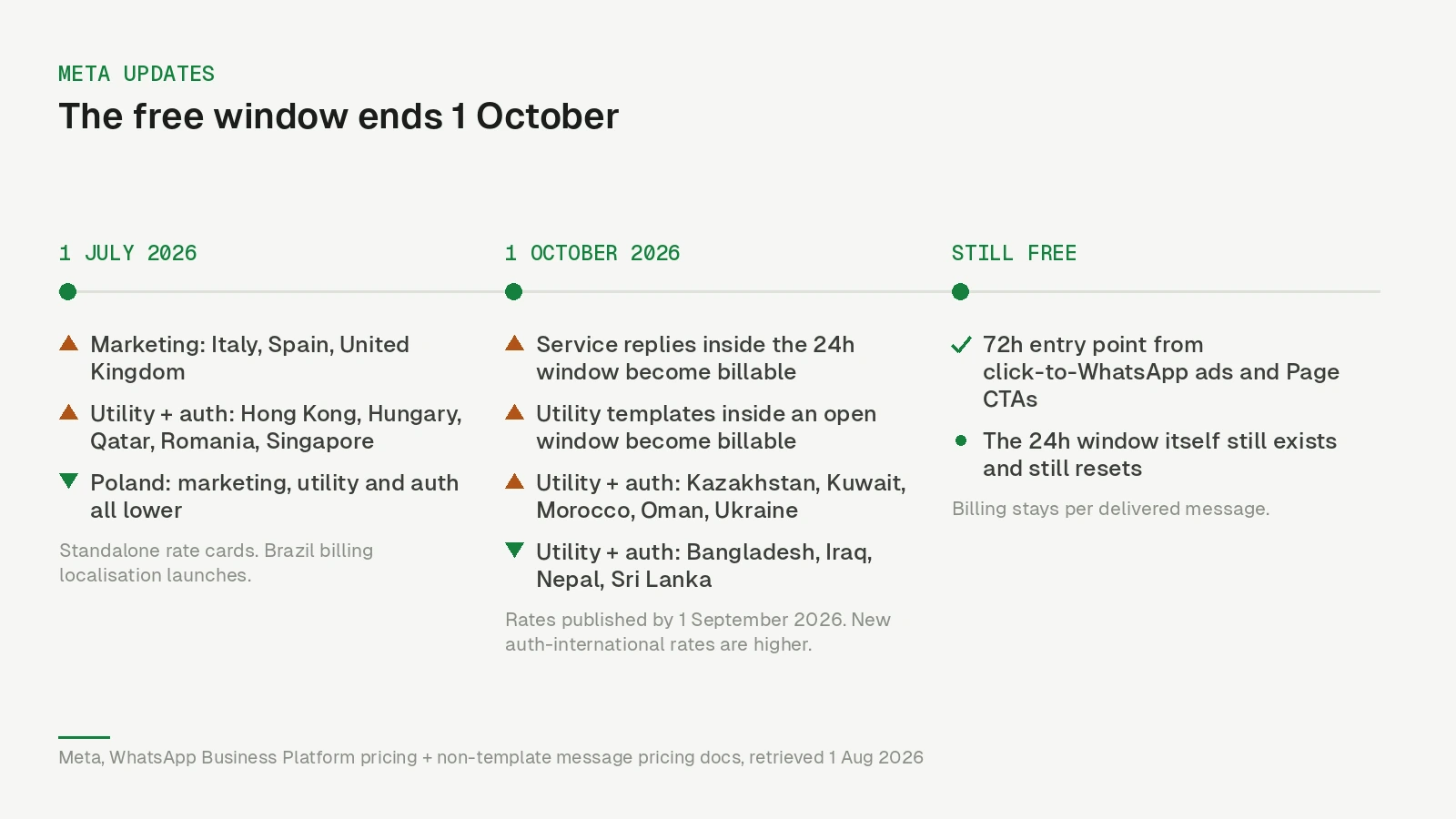
The biggest WhatsApp pricing change of 2026 is not a rate card. On 1 October 2026 the free 24-hour customer service window stops being free: Meta will charge per message for service messages and for utility messages sent in response to customers inside an open window.
That is a structural change, not a percentage. Businesses that built their model on “answer fast and the conversation costs nothing” are the ones it lands on hardest.
Here is what changes, what survives, and which of it you can do something about.
The 1 October change, in Meta’s own words
Meta’s documentation on non-template message pricing states that from 1 October 2026 it “will charge on a per-message basis for service messages, consistent with how Meta charges for template messages”, and that it “will charge on a per-message basis for utility messages sent in response to users within an open 24-hour customer service window”.
Service messages are billed at the utility and authentication rates of the market you are messaging, and unlike utility and authentication templates they are excluded from the volume tiers — there is no discount for scale. Meta said it would publish the rates that take effect on 1 October by 1 September 2026. As of 1 September, they had not yet appeared on either pricing page — when they land, that is where they will land, so check before you budget.
What stays the same is the mechanic. The window is still 24 hours, still resets on every inbound message, and still lets you send free-form messages without a template. Being inside it is simply no longer free.
| Message type | Inside an open window, from 1 Oct 2026 |
|---|---|
| Service message (free-form reply) | billed per message, at utility/authentication rates |
| Utility template | billed per message |
| Marketing template | billed (unchanged) |
| Authentication template | billed (unchanged) |
| Anything in a 72-hour free entry point window | message delivery still free (Meta Business Agent tokens are still billed) |
One separate line item worth knowing about: Meta Business Agent, Meta’s own AI, has been charged per token since 1 August 2026 at $2.00 per million tokens, which Meta estimates at roughly 4–5 US cents per message. Meta also notes that a message has only one category and is charged only for that category — token charges for the Business Agent sit on top of that logic, not inside it.
What survives: the free entry point
The 72-hour free entry point window is the exception Meta explicitly preserved. Conversations opened from a Click-to-WhatsApp ad or a Facebook Page call-to-action button stay free for message delivery, and the October announcement confirms it.
From October that makes paid social the only remaining source of free conversation volume at any scale. If you already run click-to-WhatsApp ads, the economics of that channel just improved relative to everything else.
What changed on 1 July
Meta’s pricing documentation lists the July round as a move to market-specific rate cards rather than a flat percentage change:
| Market | Change |
|---|---|
| Hong Kong, Hungary, Qatar, Romania, Singapore | Higher utility and authentication rates |
| Italy, Spain, United Kingdom | Higher marketing rates |
| Poland | Lower marketing, utility and authentication rates |
Until 30 June 2026 these markets were charged the relevant regional rate — Rest of Central and Eastern Europe in Poland’s case — so the move to a standalone card is what produced the change in either direction.
Alongside it, Brazil billing localisation launched. Eligible customers have to migrate all their WhatsApp Business Accounts to BRL by 30 June 2027, and from 1 July 2027 Meta will not deliver messages from WABAs that have not migrated. That deadline has teeth.
The European entries do not split neatly. Italy, Spain and the UK got more expensive for promotion, Hungary and Romania for transaction messages, and Poland got cheaper across the board. If you send to several of these, the direction of travel depends entirely on which market and which category.
What is coming on 1 October
Announced in advance, per the same page:
- Lower utility and authentication rates: Bangladesh, Iraq, Nepal, Sri Lanka
- Higher utility and authentication rates: Kazakhstan, Kuwait, Morocco, Oman, Ukraine
- Each of those markets also gets a new authentication-international rate that is higher than the current regional authentication rate — including the markets whose utility and authentication rates went down
For most European senders the rate cards themselves are noise. The authentication-international line is not, if you send login codes abroad at real volume. It applies when Meta deems your business eligible — currently that means very high authentication volumes — and your primary business location is in a different country than the recipient; domestic senders and low-volume senders keep the domestic rate.
On notice periods, Meta commits to at least one month for a rate card update, three months for an addition to the pricing model and six months for a change to the model itself, with updates rolled out quarterly.
What did not change
Two things survived, and it is worth being precise about which.
Billing is still per delivered template. Since 1 July 2025 the model has been per message, and the charge lands when a template message is delivered — not when it is sent, not when it is read. October changes which messages are billable, not the model.
Category still decides the rate. In most markets marketing is the most expensive of the three. Utility and authentication are cheaper, and only they benefit from the volume tiers — service messages, once they become billable, do not.
What did not survive is the assumption underneath most WhatsApp cost models: that conversation volume inside the window is free. From October, the shape of the bill changes from “how often do you pay to start talking” to “how much do you talk”.
The three levers, in order of size
1. Stay inside the window anyway. Until 30 September this lever is the free one, and afterwards it is still the cheap one: a reply inside an open window is billed at utility and authentication rates, while reopening a closed thread means a template, and a marketing template is the dearest thing you can send. Every inbound message still resets the clock for another 24 hours. So the habit does not change, only the size of the prize. We wrote up the mechanics in the 24-hour window explained.
2. Get your categories right. If your rates went up in Hungary or Romania, the change hit utility and authentication — which means it hit your transactional messaging, and the fix is not to send fewer order updates. Check the opposite direction instead: how many of your genuine transactional messages are currently classified as marketing because someone wrote a promotional sentence into them? That reclassification is a permanent surcharge on every send, and it is usually one sentence. Template categories and rejections covers how Meta decides.
If your rates went up in Italy, Spain or the UK, the change hit marketing, and there the honest lever is different: fewer, better-targeted campaigns to people who actually opted in, plus using the free entry point windows you already generate if you run click-to-WhatsApp ads.
3. Check the volume tiers. Meta applies reduced rates for utility and authentication messages above certain monthly volumes, aggregated across all WhatsApp Business Accounts in a business portfolio. Two things follow. If you are close to a threshold, the marginal message is cheaper than your current average, which changes the maths on whether to move a notification from SMS to WhatsApp. And if you run several WABAs — an agency with client accounts, say — whether they sit in one portfolio is now a budget question, not just an admin one.
What to actually do this week
Count the messages you currently send inside open windows for free, over a full month. That number is your October exposure, and almost nobody has it to hand because until now it did not appear on an invoice. Multiply it by your market’s utility rate for a first estimate, then redo the sum the moment Meta actually publishes the October rates.
Then split your paid spend three ways: templates sent to reopen a closed conversation, templates sent as genuine transactional notifications, and marketing campaigns. Mostly reopening costs means a response-time problem. Mostly transactional means a category audit. Mostly marketing in Italy, Spain or the UK means the July change landed on you directly.
One caveat on everything above: rates change, and any figure in a blog post is a snapshot. Meta’s pricing pages are the source of truth, and they are the only thing worth quoting to your finance team.
What this means for you
Nybero does not mark up WhatsApp conversation costs — Meta bills those directly, and we show you what they were rather than reselling them, which is why our pricing is a flat monthly plan, not a per-message bill. What the platform does do is aimed squarely at the first lever: the inbox shows whether each customer service window is still open, automations pause instead of burning a template when a window has closed, and the AI agent answers at the hours when nobody is at a desk, which is exactly when windows quietly expire.
Updated 1 September 2026. An earlier version of this article stated that replies inside the 24-hour window remain free and that Poland’s rates went up; both were wrong, and the article has been corrected against Meta’s pricing documentation and its announcement on non-template message pricing, both last re-checked 1 September 2026. Rates change; check those pages before you budget.