
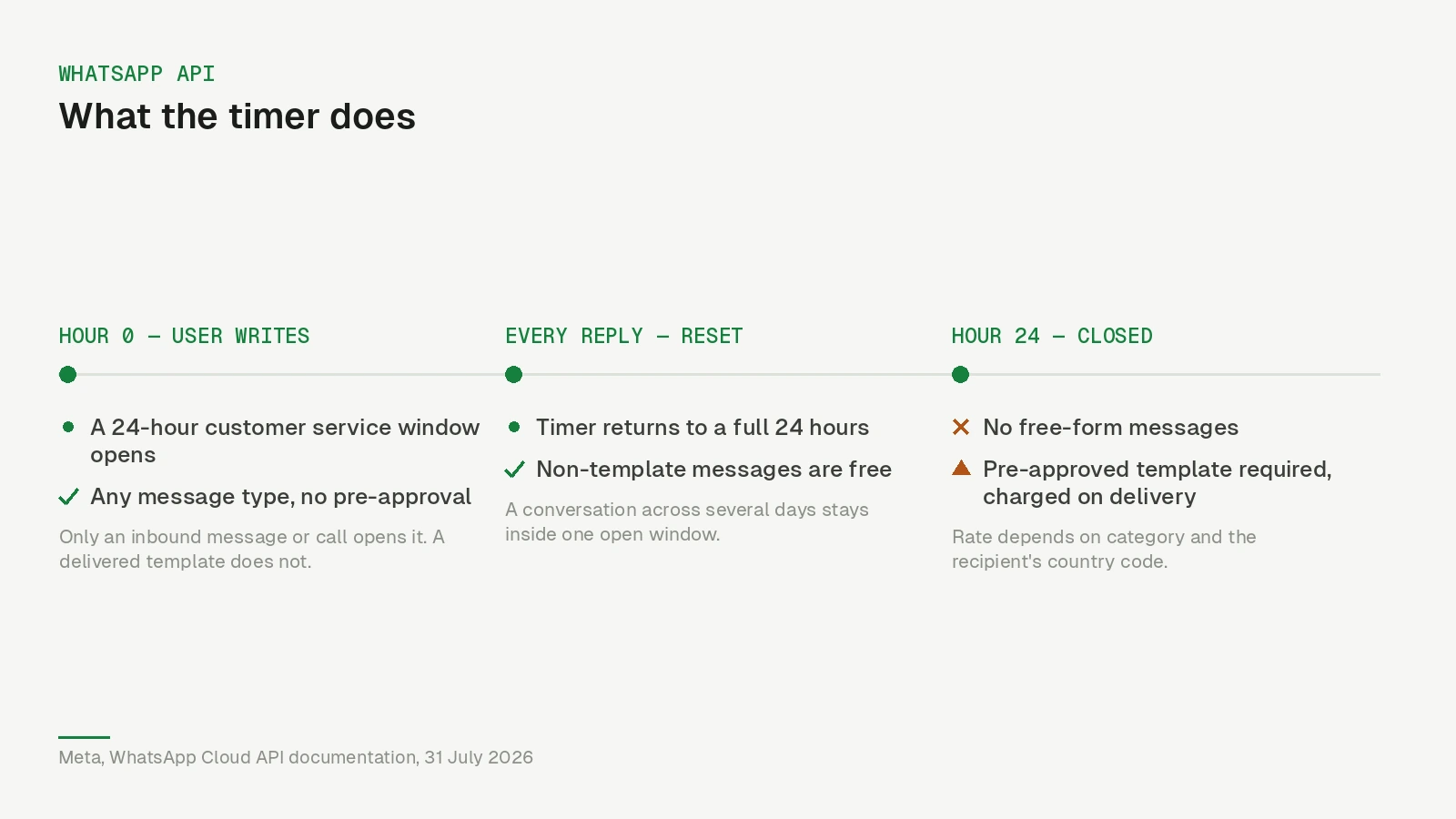
The customer service window is the single mechanic that decides what you can say on WhatsApp and what it costs. It is simple: when a user messages or calls your business, a 24-hour timer starts. While it runs, you can send whatever message type you like. When it expires, you can only send templates Meta approved in advance.
Meta’s own wording, from the Cloud API documentation: “When a WhatsApp user messages you or calls you, a 24-hour timer called a customer service window starts.” And when it ends: “When the window closes, you can only send pre-approved template messages.”
Everything else in this article follows from those two sentences.
What opens it, and what does not
The window opens on a user-initiated inbound event — a message, or a call. That is it.
It does not open when you send a template. It does not open when the template is delivered, or read. A person can read your message, screenshot it, forward it to a friend and never reply, and your window stays shut. Delivery is not engagement.
It resets on every new inbound message. So a support conversation that runs across three days is one window that keeps being renewed, not three windows.
Inside the window
While the timer runs you are in free-form territory. Text, images, documents, audio, video, interactive buttons and lists — none of it needs pre-approval, and you compose it as you go.
This is where actual conversation happens: answering a question, sending the invoice someone asked for, walking a customer through a return, letting an AI agent handle the back-and-forth at two in the morning. Until 30 September 2026 it is also free: non-template messages within an open customer service window are not charged. That ends on 1 October 2026, when Meta begins charging per message for service messages and for utility messages sent inside an open window, at the market’s utility and authentication rates (Meta’s announcement has the details). The window still works the same way — it is simply no longer free to be inside it.
The constraint is not technical, it is behavioural. The window is called a customer service window for a reason, and Meta’s Business Messaging Policy governs what you put in it. Answering the question someone asked is fine. Turning their support ticket into a promotion is how businesses lose their quality rating.
Outside the window
Once it closes, one door remains: an approved template.
Templates come in three categories and the category determines the price. Utility templates relate to an existing transaction — order updates, appointment reminders, delivery notifications. Authentication templates carry one-time codes. Marketing is everything promotional, and in most markets it is the most expensive of the three.
Since 1 July 2025, Meta charges per message rather than per conversation, and the charge lands when a template message is delivered. Rates vary by category and by the recipient’s country code, and Meta adjusts them periodically — several European markets moved onto standalone rate cards on 1 July 2026, and another round takes effect on 1 October (the details are here). Check the official pricing page for the current rate in the markets you actually message; anything quoted in a blog post, including this one, is a snapshot.
There is one useful exception. Conversations that start from a Click-to-WhatsApp ad or a Facebook Page call-to-action can open a free entry point window of 72 hours rather than 24 — it opens the moment you reply within the first 24 hours, and messages inside it are not charged. It stays free after 1 October too. If you run click-to-WhatsApp ads and answer promptly, that is three days of free messaging per person who clicks.
The economics, stated plainly
Until October, the cost of your WhatsApp programme is roughly: number of times you have to reopen a closed conversation × the template rate in that market. From 1 October 2026 you add the messages you send inside open windows, billed at the utility and authentication rates — so volume starts to matter alongside reopenings. Two things to know before you budget: Meta offers no volume tiers for service messages, and as of 1 September 2026 the concrete per-market service rates had not yet appeared on the rate cards, although Meta said it would publish them ahead of October. Check before you plan.
Two businesses sending the same volume can differ by a factor of five on the invoice, and the difference is almost never the rate they negotiated. It is how often they had to knock on a closed door.
Which leads to the part that is actually actionable.
Three habits that keep you inside the window
Answer fast enough to matter. The window is 24 hours; most of the value is in the first hour. A reply that arrives in ten minutes gets a response, and that response resets the timer. A reply that arrives the next morning arrives to a closed window and costs you a template to reopen. If you cannot staff the evening, an AI agent that handles the first response is not a luxury — it is the thing that keeps the window open.
End messages with a reason to reply. Not “let us know if you need anything”, which nobody answers. A question, or two buttons. Every reply is another 24 hours.
Batch what you were going to send anyway. If you know you owe someone three things, and the window is open, send them now rather than as three separate templates over the next week.
A fourth, less obvious one: watch the end of the window rather than the start. A message sent at hour 23 is a cheap service message; the same message at hour 25 costs a template, and a marketing template is dearer still. Any decent platform will show you which conversations are about to expire.
Where people get caught out
Assuming a delivered template opens the window. It does not. This is the single most common misunderstanding, and it produces sequences where every step is billed because none of them ever got a reply.
Treating the window as permission. It is a technical capability, not consent. Someone who messaged you about a delayed order has not agreed to your Black Friday campaign. Under the GDPR you need a separate opt-in for marketing, and what that opt-in has to look like is a topic of its own.
Sending a marketing template where a utility one would do. Categories are Meta’s call, not yours, and a promotional line inside an “order update” gets the template rejected or reclassified. But it works in the other direction too: a genuine appointment reminder is a utility template, and businesses routinely pay marketing rates for it because someone wrote it like an advert.
Ignoring the free entry point. If you already run click-to-WhatsApp ads, you have 72-hour free windows arriving daily and probably no follow-up designed for them.
What this means for you
Look at your last month of WhatsApp spending and split it in two: templates sent because there was genuinely no open window, and templates sent because nobody replied in time. The second number is the one you can fix, and it is usually the larger one.
Then fix it in this order — response time first, reply-inviting endings second, template category audit third. In Nybero this is visible directly in the inbox: conversations show whether their window is open, automations pause when a window closes rather than burning a template, and the AI agent answers at the hours when nobody is at a desk. That is the whole trick. Stay in the conversation — free until October, and cheaper than reopening it ever after.
Pricing mechanics as documented by Meta on 1 September 2026. Rates change; the pricing page is the source of truth.