
Nothing about WhatsApp itself changes when you switch provider. Every platform runs on Meta’s Cloud API, needs the same approved templates, obeys the same 24-hour window, and pays Meta per delivered message — including, from 1 October 2026, free-form replies inside that window, which Meta will bill per message at utility-level rates. The differences are entirely in the layer above — pricing model, caps, data location, contract — and that is the only place worth comparing.
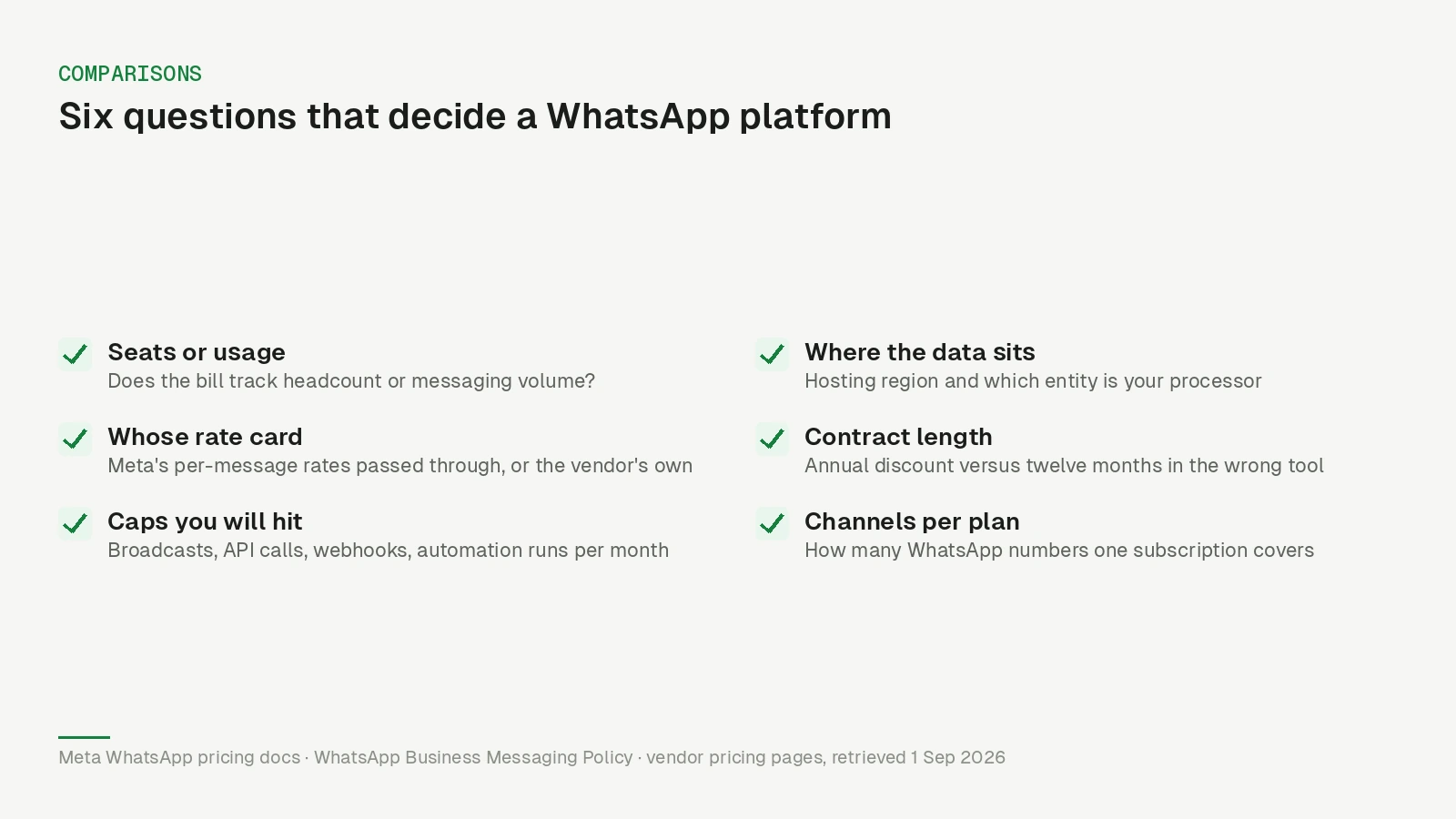
Which makes most feature grids beside the point. Six questions decide it, and four of them are on the pricing page rather than the feature page.
What is identical no matter who you pick
Worth stating plainly, because vendor comparisons rarely do:
- Meta’s charge. Since 1 July 2025 Meta bills per message, and its pricing documentation is explicit: “You are only charged when a template message is delivered.” Marketing, utility and authentication each have their own rate, varying by market. That sentence has an expiry date, though: per Meta’s non-template pricing page, service messages and utility templates inside the 24-hour window become per-message billed on 1 October 2026 — the details are here — and the main pricing page has not caught up yet. Either way, the change applies to every provider equally. No provider negotiates that away.
- Template approval. Per the WhatsApp Business Messaging Policy, “you may only initiate conversations using an approved Message Template”, and Meta may “review, approve, pause and reject any Message Template at any time”.
- Opt-in. The same policy requires that people “have given you their mobile phone number” and that “you have received opt-in permission” — regardless of which dashboard you send from.
- Quality-driven limits. Meta ties automatic increases in your messaging limits to sending high-quality messages, not to the plan you bought.
- Your number. It is yours, and switching provider is a migration rather than starting from scratch. Templates are the caveat: per Meta’s template migration documentation, “migration doesn’t move templates; it recreates them in the destination WABA”, only templates that are
APPROVEDwith aquality_scoreofGREENorUNKNOWNare eligible, and individual templates can still fail migration — for an incorrect category, for instance.
If a comparison page implies otherwise about any of these five, that tells you something about the page.
The six things that actually differ
1. Seats or usage. Does the bill track headcount or messaging? Per-seat pricing is predictable while the team is stable and becomes the single most common reason to go shopping when it is not.
2. Whose rate card. Some providers pass Meta’s per-message rates straight through; others resell messages on their own card, with the margin folded in. Both are legitimate business models. Only one of them lets you predict your bill from Meta’s published rates.
3. Caps you will actually hit. Broadcast volume per month, API calls per month, webhook availability, automation runs. These are the numbers that decide whether the plan you signed is the plan you can use in month six.
4. Where the data sits, and who the processor is. Relevant to your Article 30 record and your DPA, and the one item on this list that a support ticket cannot fix later. We went through the whole chain in where does WhatsApp Business data go.
5. Contract length. Annual discounts are real, and so is being twelve months into the wrong tool.
6. Channels per plan. How many WhatsApp numbers one subscription covers, which matters the moment you add a second brand, a second market, or a support number next to the marketing one.
How Wati’s plans are structured today
Neutral, from Wati’s pricing page as retrieved on 1 September 2026 — check it yourself before deciding anything, because pricing pages move:
| Growth | Pro | Business | |
|---|---|---|---|
| Channels | ”connect any 1 channel” | not stated | ”multiple WhatsApp numbers” listed as a feature |
| Users included | 3 | 5 | 5 |
| Extra users | ”no additional users” | $24/user/month | $69/user/month |
| Broadcasts | 15k/month, standard rates | unlimited, standard rates | unlimited, volume discounts |
| API calls | 10k/month, no webhooks | 200k/month, limited webhooks | 20M/month, extensive webhooks |
| Messages | separate | separate | separate |
There is also a pay-as-you-go single-user plan listed separately at a one-time fee in rupees.
Two structural notes rather than judgements. Seats are a line item above the entry plan, at two different rates depending on tier, so the bill moves with the team. And messages are “charged based on WATI rate card”, with the page noting that “per message charges vary for marketing, utility & authentication” — which is question two on the list above, answered.
The plans also carry a “7 days free trial, zero setup fees”. Anything beyond this — feature depth, support quality, how the product feels on day thirty — is not something we can source, so we will not characterise it.
What this means for you
Run the same six questions against every tool on your shortlist, including the one you are already paying for. In writing, with numbers:
- What does this cost with the team I will have next year, not the one I have today?
- Am I billed Meta’s message rates or the vendor’s?
- Which cap do I hit first — broadcasts, API calls, or automations?
- Where is the data, and which entity is my processor?
- How long am I committed for?
- How many numbers does one subscription cover?
Then price a real campaign — your actual recipient count, at Meta’s rate for your actual market — and add the subscription. That number is the comparison. Feature lists rarely change it by much.
For what it is worth on question six, Nybero prices by channel rather than by seat, and Meta bills your messages directly to your own WhatsApp Business Account rather than through us; the Wati alternative page sets out where it fits and where it does not, including what it deliberately leaves out. If your reason for looking is question four, start there instead.